Using the Inline Forms/ Surveys Element in email campaign
Modified on: Thu, 1 Oct, 2026 at 12:53 AM
Inline Forms and Surveys let you collect quick feedback directly from an email campaign using rating, scoring, and sentiment-based response options. When a recipient selects an option, HighLevel records the response in the campaign's submission data, and you can optionally redirect the recipient to a Success URL afterward. This makes the element useful for satisfaction surveys, NPS-style feedback, content ratings, and other lightweight feedback requests.
TABLE OF CONTENTS
- What is the Inline Forms and Surveys Element?
- Key Benefits of Inline Forms and Surveys
- Supported Feedback Types
- How Responses Are Tracked
- Success URLs and Post-Response Redirects
- Reviewing Inline Feedback Submissions
- Exporting Inline Feedback Responses
- Changing the Feedback Type While Editing
- Email Client Considerations
- How to Add an Inline Form or Survey to an Email Campaign
- Frequently Asked Questions
- Related Articles
What is the Inline Forms and Surveys Element?
The Inline Forms and Surveys element is an Email Campaign element designed to collect quick feedback from recipients without requiring them to complete a traditional multi-field form. Instead, contacts interact with options such as ratings, scores, or Like/Dislike responses directly from the email experience.
The element is different from a standard HighLevel Form or Survey created under Sites. Responses from the email element are tracked with the campaign and can be reviewed under Campaign Statistics > Submissions.
When a recipient selects a response:
HighLevel records the selection.
The response becomes available in the campaign's submission data.
If a Success URL is configured, the recipient is redirected to that destination.
The recipient does not need to complete the redirect for the initial feedback response to be recorded.
Key Benefits of Inline Forms and Surveys
Inline feedback removes unnecessary steps between asking a question and capturing a response. Instead of directing every recipient to a separate survey before their feedback can be recorded, you can collect lightweight responses from the email interaction itself.
Quick feedback collection: Capture ratings, scores, and simple sentiment responses with fewer steps for recipients.
Campaign-level reporting: Review submitted feedback directly from the associated campaign statistics.
Flexible feedback types: Choose the response style that best matches the question you are asking.
Optional post-response redirect: Send recipients to a thank-you page, follow-up offer, or another destination after their response is recorded.
Clear response identification: Use a unique Title for each feedback element so its submissions are easier to identify in campaign reporting.
Supported Feedback Types
Different feedback formats work better for different questions. Choosing the simplest format that matches your goal makes the interaction easier for recipients and the resulting responses easier to interpret.
Available options can include feedback formats such as:
1–10 scoring: Useful for recommendation likelihood, satisfaction scoring, or other numeric feedback.
Like/Dislike: Useful for simple positive or negative sentiment.
5-star rating: Useful for product, service, content, or experience ratings.
NPS-style feedback: Useful when you want recipients to provide a recommendation-style score.
For example:
Use Like/Dislike to ask whether an article was helpful.
Use a 5-star rating to ask customers to rate a recent experience.
Use a 1–10 score for recommendation or satisfaction feedback.
How Responses Are Tracked
Understanding when HighLevel records a response helps you interpret campaign submissions correctly and prevents confusion between the feedback click and any page the recipient visits afterward.
HighLevel records the response when the contact clicks one of the feedback options in the email.
The typical recipient flow is:
The contact opens the email.
The contact selects a rating, score, or feedback option.
HighLevel records the response.
The response appears under Campaign Statistics > Submissions.
If a Success URL is configured, the contact is redirected to that page.
The Success URL does not need to finish loading for the feedback selection itself to be recorded.
Use a Unique Title
Each Inline Forms and Surveys element should have a clear, unique Title. The Title helps you identify which feedback element produced a submission when reviewing campaign results.
For example, instead of naming multiple elements:
Feedback
Use descriptive titles such as:
Post-Purchase Satisfaction
Webinar Rating
Newsletter Content Feedback
September NPS Score
Success URLs and Post-Response Redirects
A Success URL lets you control where recipients go after submitting their feedback. The redirect is optional and does not determine whether HighLevel records the original response.
You can use the Success URL to send contacts to:
A thank-you page
A follow-up survey
A product or service page
A review request
A booking page
Additional educational content
Another relevant campaign destination
For example, you could ask:
How useful was this guide?
After the recipient selects a rating, the Success URL could take them to a page with additional resources.
If you do not need a post-response destination, you can leave the Success URL unconfigured where supported.
Reviewing Inline Feedback Submissions
Inline email feedback is tied to the email campaign rather than the standard Forms and Surveys submission area. Reviewing responses from the correct reporting location helps keep campaign feedback separate from standalone HighLevel Forms and Surveys.
To review responses:
Open the relevant email campaign.
Navigate to Campaign Statistics.
Open the Submissions area.
Review the responses associated with the Inline Forms and Surveys element.
Use the element's unique Title to distinguish between multiple feedback requests where applicable.
Inline Feedback vs. Standard Forms and Surveys
Inline email feedback should not be confused with standalone HighLevel Forms or Surveys.
Inline Forms and Surveys in Email Campaigns
Designed for quick email feedback.
Responses are tracked with Campaign Statistics.
Common formats include ratings, scores, and sentiment selections.
Standard HighLevel Forms and Surveys
Created and managed separately under the Forms/Surveys tools.
Can contain broader field and question configurations.
Have their own submission, analytics, and workflow features.
Do not assume an inline email feedback response automatically appears in the standard Forms or Surveys submissions area.
Exporting Inline Feedback Responses
Exporting campaign feedback can help you review responses outside HighLevel, share results with your team, or perform additional analysis.
From the campaign's submission reporting, use the available export option to download response data where supported.
Before exporting, confirm that you are viewing the correct:
Campaign
Feedback element Title
Submission set
Changing the Feedback Type While Editing
Changing the feedback type allows you to compare different interaction styles while building the campaign. HighLevel can preserve the previous configuration when you switch back to a feedback type during the same editing session.
For example, you may start with a 5-star rating, switch to Like/Dislike, and then return to the 5-star option while editing.
When switching types, review the element again before saving to confirm:
The intended feedback type is selected.
The Title is still appropriate.
The visual settings are correct.
The Success URL is still appropriate for the interaction.
Email Client Considerations
Email clients can handle interactive or responsive email content differently. Testing helps you verify that the feedback options remain understandable and clickable for recipients using different inbox applications.
Before sending the campaign:
Preview the email in the Email Builder.
Send a test email.
Confirm the feedback options are visible.
Verify each response option is clickable.
Confirm the response is recorded.
Test the Success URL if one is configured.
Where possible, test the email in the major email clients used by your audience. Avoid assuming that interactive email content will render identically in every inbox.
How to Add an Inline Form or Survey to an Email Campaign
Proper setup ensures that recipients can understand the feedback request, responses are easy to identify in reporting, and optional redirects lead to the correct destination.
Navigate to Marketing > Emails > Campaigns.
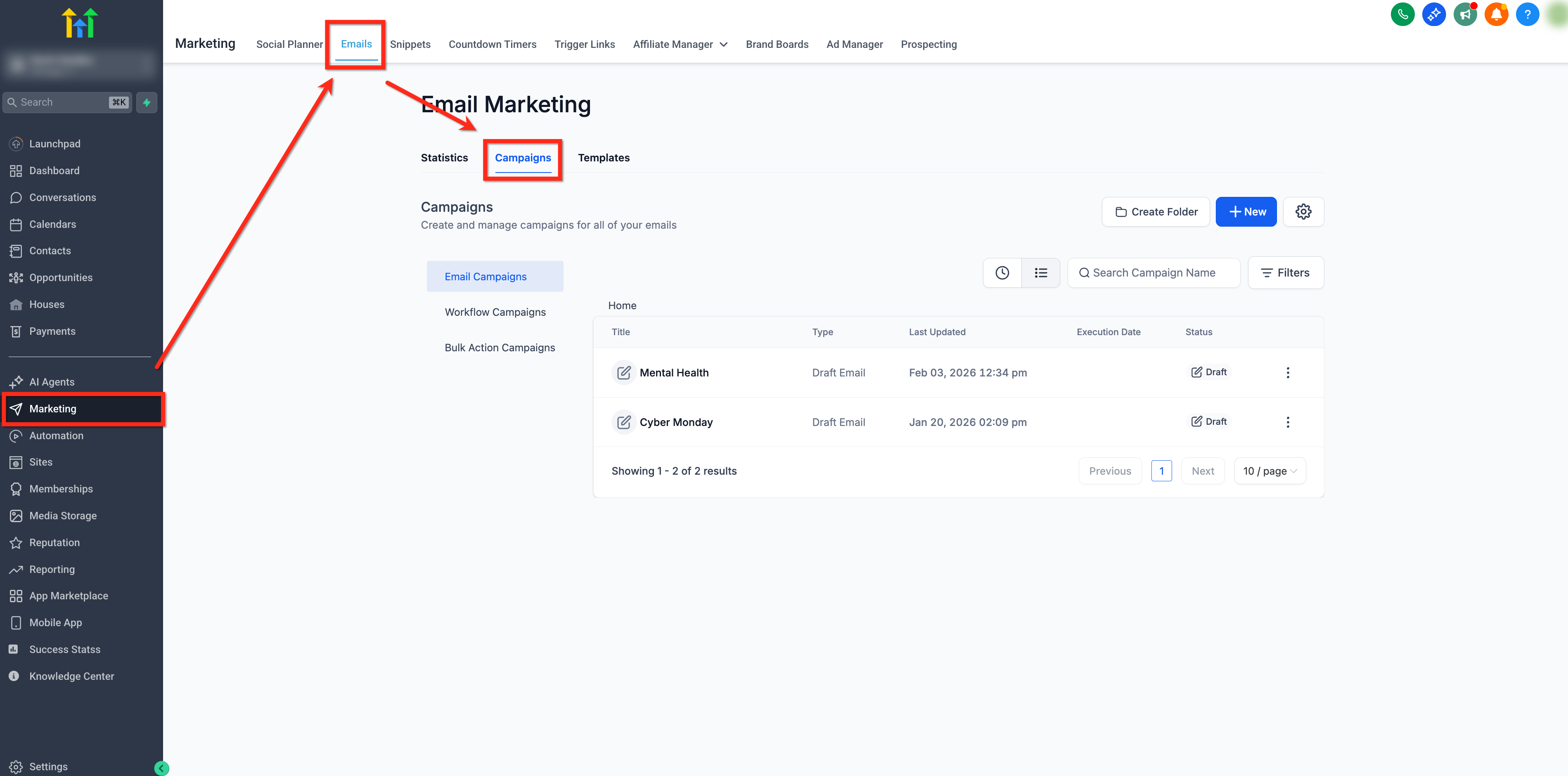
Create a new campaign or open the campaign you want to edit.
Open the campaign in the Email Builder.
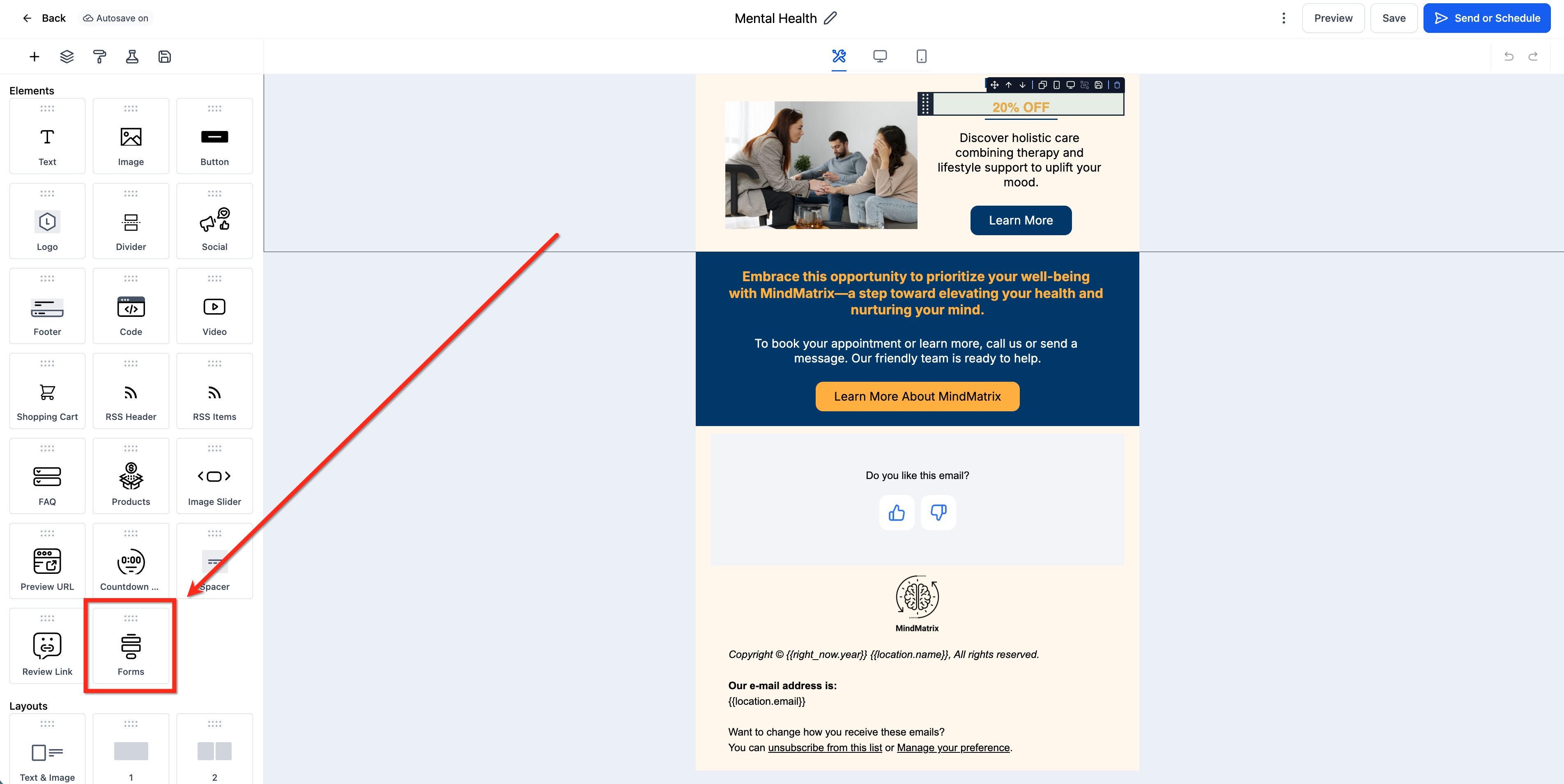
Locate the Forms/Surveys element in the Elements panel.
Drag the element into the desired location in the email.
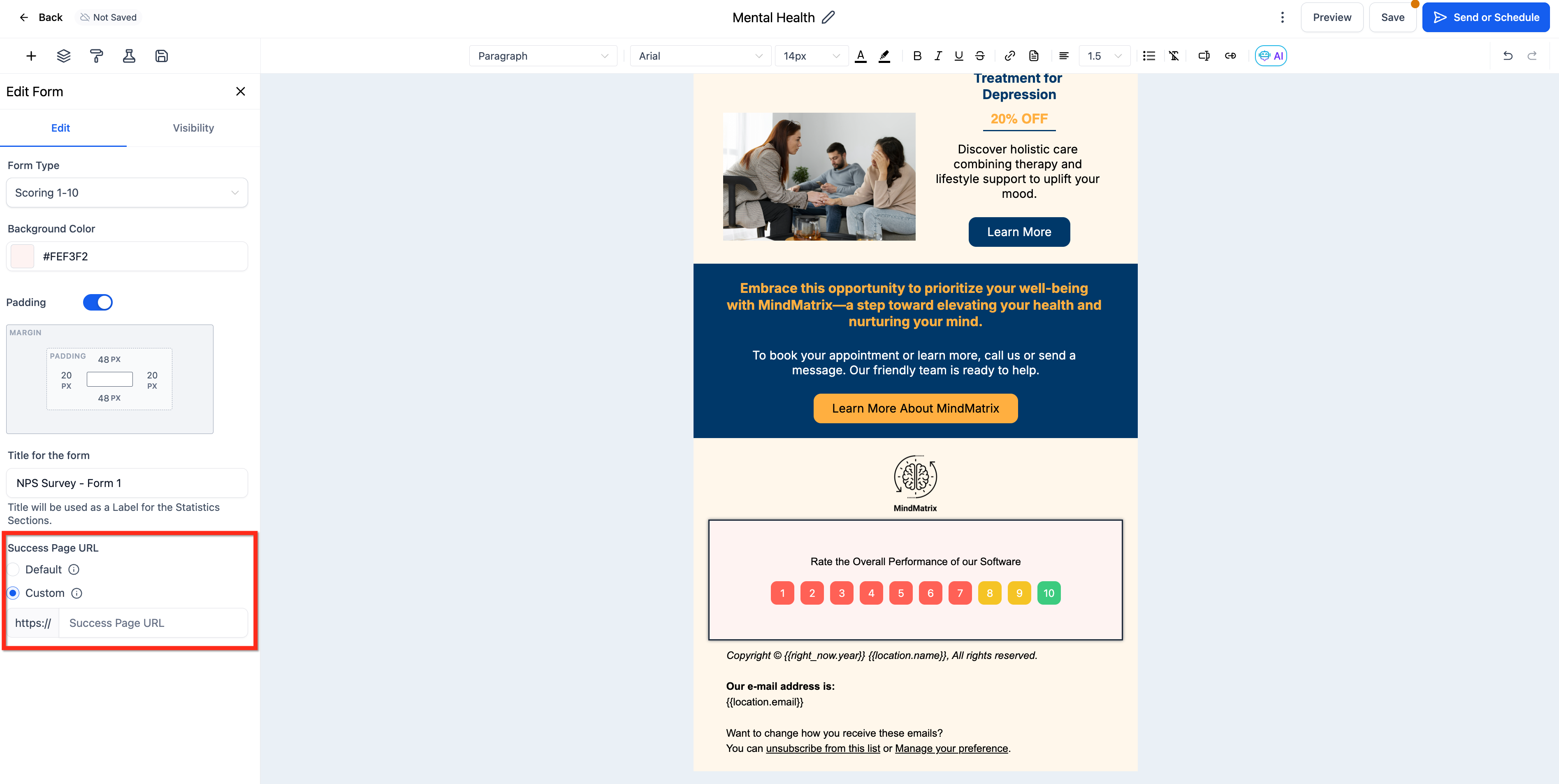
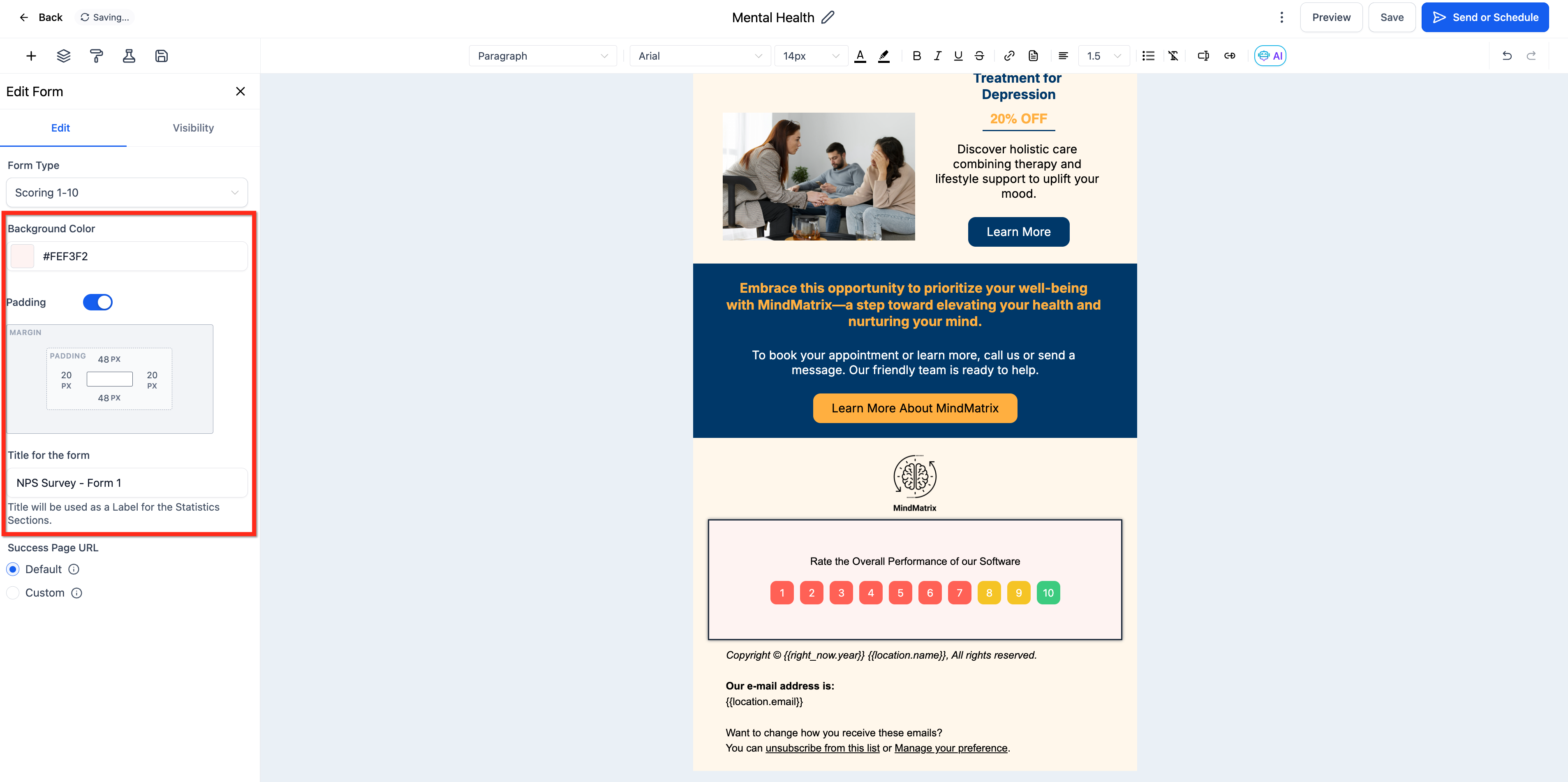
Select the feedback type you want to use. Depending on the available configuration, this may include:
1–10 scoring
Like/Dislike
5-star rating
NPS-style feedback
Configure the element's appearance and available settings.
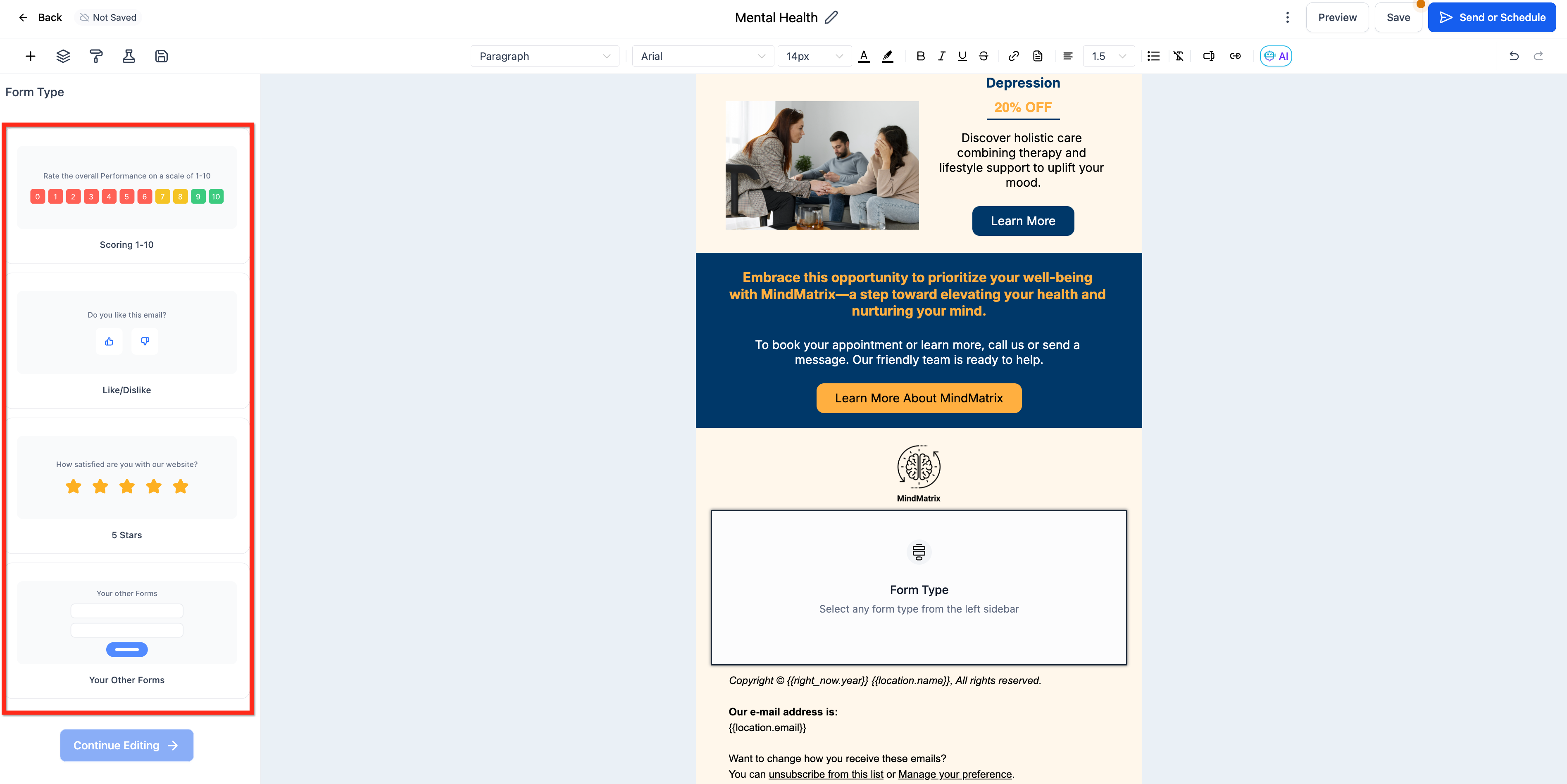
Enter a unique Title. Use a descriptive name so the response is easy to recognize under Campaign Statistics > Submissions.
Configure a Success URL if you want recipients to be redirected after selecting a response. The Success URL is optional and does not control whether the initial response is recorded.
Review the feedback element in the email preview.
Save the campaign.
Send a test email to yourself.
Select a feedback option in the test message.
Confirm:
the click works,
the optional redirect opens,
and the response appears under Campaign Statistics > Submissions.
Send the campaign when testing is complete.
Frequently Asked Questions
Q: When is an inline feedback response recorded?
HighLevel records the response when the recipient clicks one of the available feedback options in the email.
Q: Is a Success URL required?
No. The Success URL is optional. The feedback response can be recorded from the click even when no post-response redirect is required.
Q: Does the recipient have to reach the Success URL for the response to count?
No. The response is recorded from the feedback click itself. The Success URL controls what happens after the interaction.
Q: Where can I view the responses?
Open the associated email campaign and review Campaign Statistics > Submissions.
Q: Why should every feedback element have a unique Title?
A unique Title makes it easier to identify which Inline Forms and Surveys element generated a response in campaign reporting.
Q: Can I change the feedback type while building the email?
Yes. You can change the feedback type while editing. HighLevel can restore the previous settings if you switch back to the original type during the same editing session.
Q: Is this the same as a standard HighLevel Form or Survey?
No. The inline email element is designed for quick campaign feedback and its responses are documented under Campaign Statistics. Standard Forms and Surveys have separate builders, submissions, analytics, and automation features.
Q: Does inline feedback trigger the standard Form Submitted workflow trigger?
The current HighLevel documentation for this email element does not establish that inline feedback fires the standard Form Submitted trigger. Do not build automation around that assumption unless the behavior is confirmed for your use case.
Q: Does inline feedback trigger the standard Survey Submitted workflow trigger?
The current documentation does not establish that these campaign feedback clicks fire the standard Survey Submitted workflow trigger. Standard Survey submissions and inline email feedback should be treated as separate features unless explicitly connected.
Q: What happens if a contact clicks more than one response option?
Current HighLevel documentation does not define repeated-click behavior for this element. Test the behavior before designing a campaign that depends on contacts being able to revise or submit multiple responses.
Q: Can I use the element in Workflow emails or one-to-one emails?
The documented workflow for this feature is currently centered on Marketing > Emails > Campaigns. Availability in other email surfaces should be verified before relying on it outside Campaigns.
Related Articles
Was this article helpful?
That’s Great!
Thank you for your feedback
Sorry! We couldn't be helpful
Thank you for your feedback
Feedback sent
We appreciate your effort and will try to fix the article