Feature Guide WhatsApp Calling Handle inbound and outbound voice calls directly through WhatsApp — giving your team complete context for every customer interaction from a single platform. |
What you'll learn
|
TABLE OF CONTENTS
- What Is WhatsApp Calling?
- How to Enable WhatsApp Calling
- Country Availability
- WhatsApp Inbound Calls
- Setting Up WhatsApp Calling
- Setting Up WhatsApp Call Permissions
- Making and Receiving WhatsApp Calls
- Configure Staff User Calling Settings
What Is WhatsApp Calling? Voice and chat in one place — no app switching required |
Accessing WhatsApp Calling (Beta)

WhatsApp Calling is currently in beta and is not yet available to all users. To request access, please complete the beta access form:
https://api.leadconnectorhq.com/widget/form/xpGWoA9VnKVWRqr4oibs
WhatsApp Calling allows you to speak with your customers in real time, offering a more personal and immediate connection compared to text-only messaging. It is especially useful for resolving complex questions, closing deals faster, or providing high-touch support.
When WhatsApp Calling is available directly within your CRM, you no longer need to switch between multiple apps or devices. All voice and chat interactions are managed in one place.
With this integration, you can:
| |
| |
| |
|
How to Enable WhatsApp Calling Activate calling for your sub-account |
To activate WhatsApp Calling for your sub-account, click the provided activation link and complete the request form with the required details. Once submitted, WhatsApp Calling access will be enabled for your sub-account within 24 hours.
Requirements — Before using WhatsApp Calling, ensure the following:

✓  The WhatsApp number must be supported by Meta's WhatsApp Business API.
✓  WhatsApp Calling is NOT supported for Coexistence (WhatsApp App + API on the same number).
✓  The business must have a messaging limit of at least 2,000 business-initiated conversations in a rolling 24-hour period. More details on scaling your account capabilities.
Country Availability WhatsApp Calling is available in most countries |
WhatsApp Calling is available in most locations. However, Business initiated calls (BIC) is currently not supported in the following countries:
|
|
If your business or customer is located in one of these countries, Business initiated calls (BIC) will not be available at this time.WhatsApp Inbound Calls (Customer-Initiated) When a customer calls you directly via WhatsApp |
Inbound calls occur when a customer calls your business via WhatsApp. These calls will appear inside your CRM like any other notification. You can answer, decline, or let the call go to voicemail if configured.
How it works in CRM:
| |
| |
|
Setting Up WhatsApp Calling Configure your phone number and assign users to handle calls |
Step 1 Open WhatsApp and go to Settings.
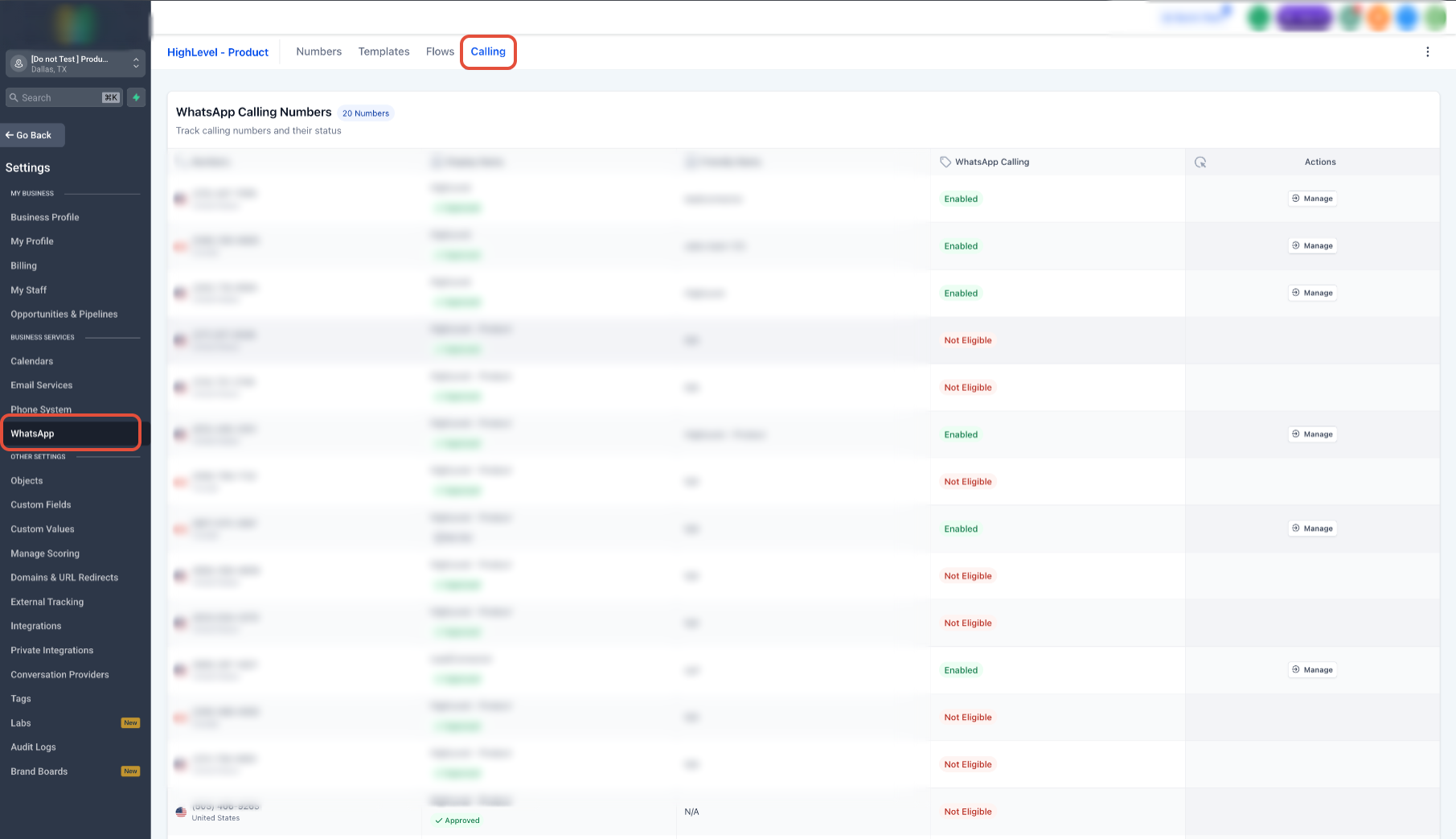
Step 2 Select Calling from the menu.
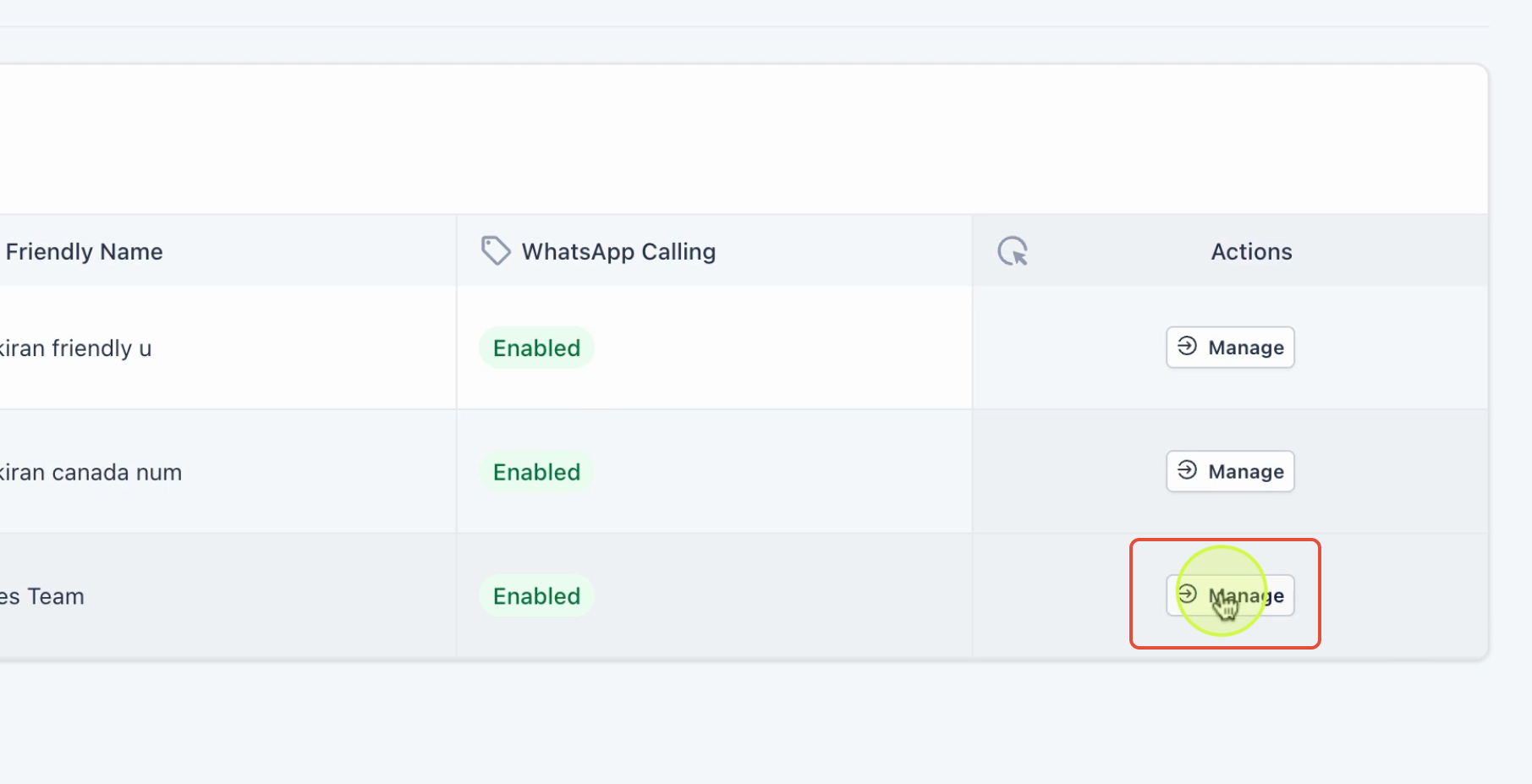
Step 3 You will see a list of phone numbers currently showing as connected. Identify the number you want to set up for calling.
Step 4 Find the number you want to configure and click Manage.
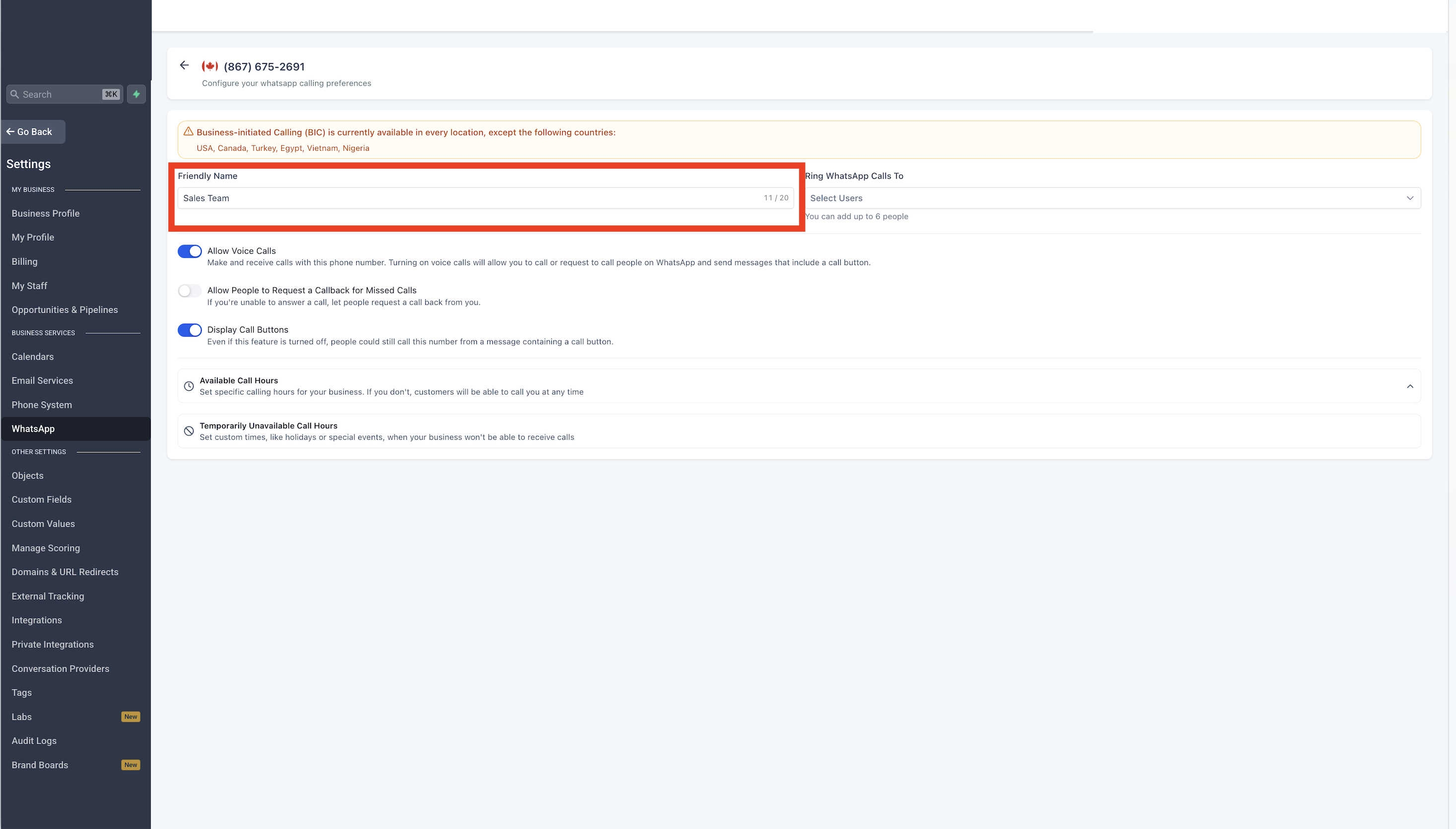
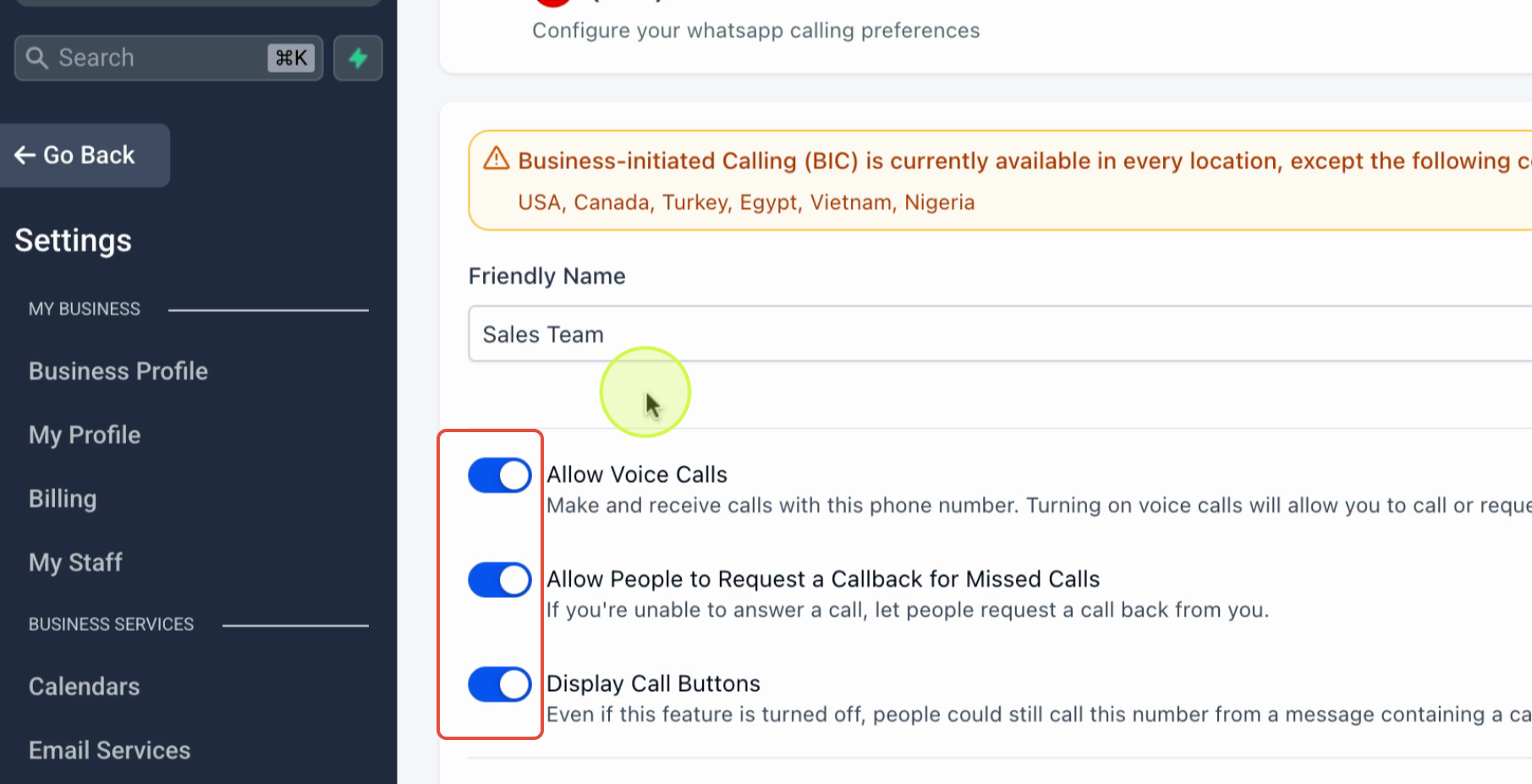
Step 5 Assign a friendly name (e.g., Sales Team) for easy identification across your workspace.
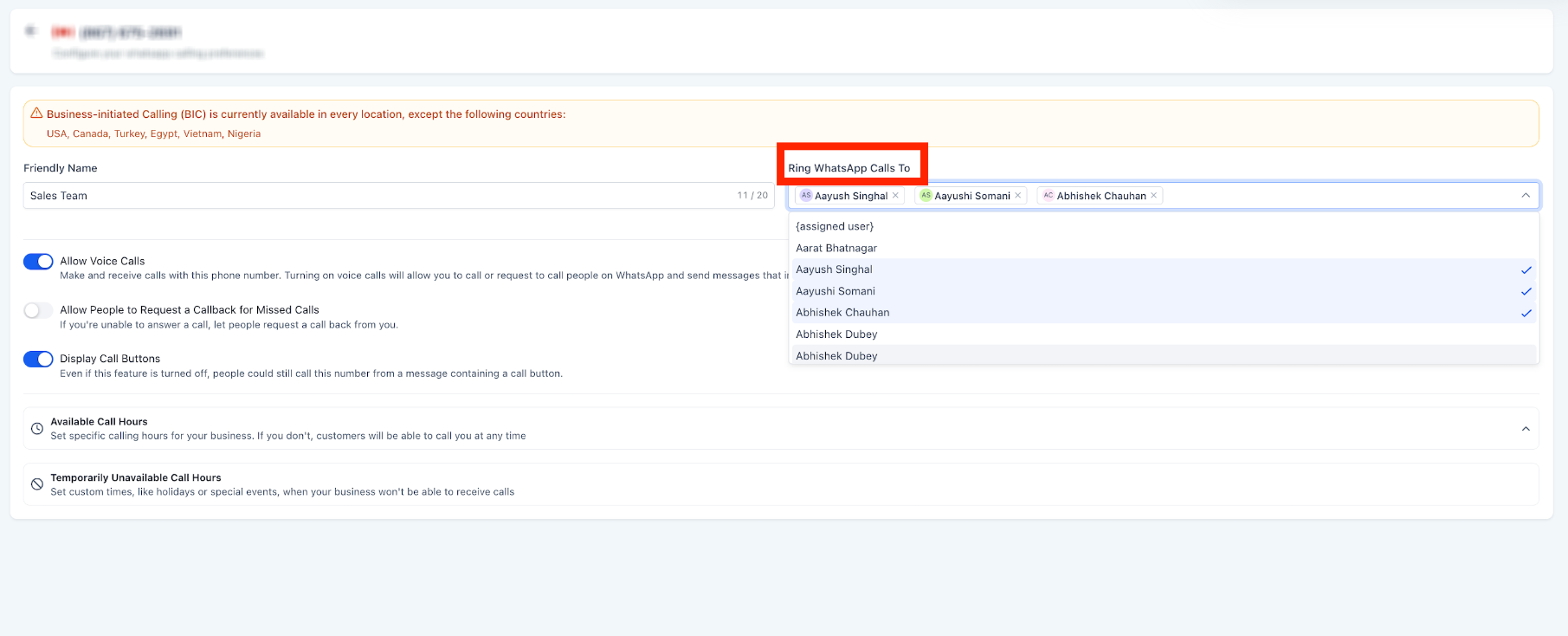
Step 6 Under Ring WhatsApp Calls To, add the users who should receive inbound calls. Set a primary user to ring first, and add additional users as backup if needed.
Step 7 Enable Allow Voice Calls to activate WhatsApp Calling for this number. Turn on Allow People to Request Callback for Missed Calls so customers can request a return call if their call goes unanswered.
Step 8 Toggle Display Call Button so customers see a call option directly on your WhatsApp business profile.
Step 9 Set up Available Callers and Temporarily Unavailable Callers based on your team's schedule and availability.
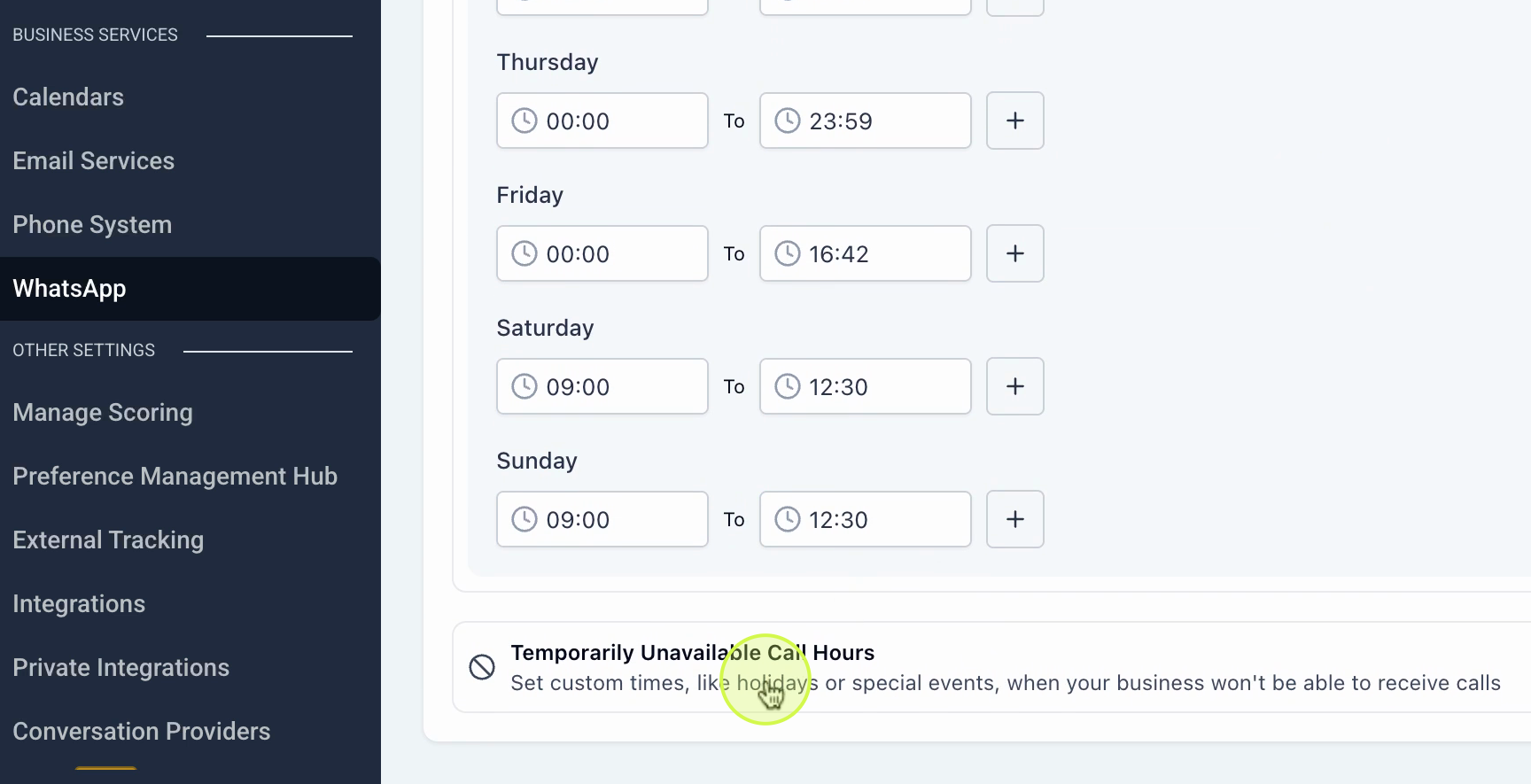
? Tip: Keep your caller availability updated to ensure inbound calls are always routed to the right person and to reduce missed calls.
Setting Up WhatsApp Call Permissions Request and manage customer call permissions |
Important: WhatsApp requires explicit customer approval before calling can be enabled for a contact. Always confirm permission is active before initiating a call.
Step 1 Go to Settings > WhatsApp Templates.
Step 2 Create a new template requesting call permission from your customers.
Step 3 Under Call-to-Action Buttons, select WhatsApp Call Permissions. This adds a button to the template that customers can tap to grant you calling access.
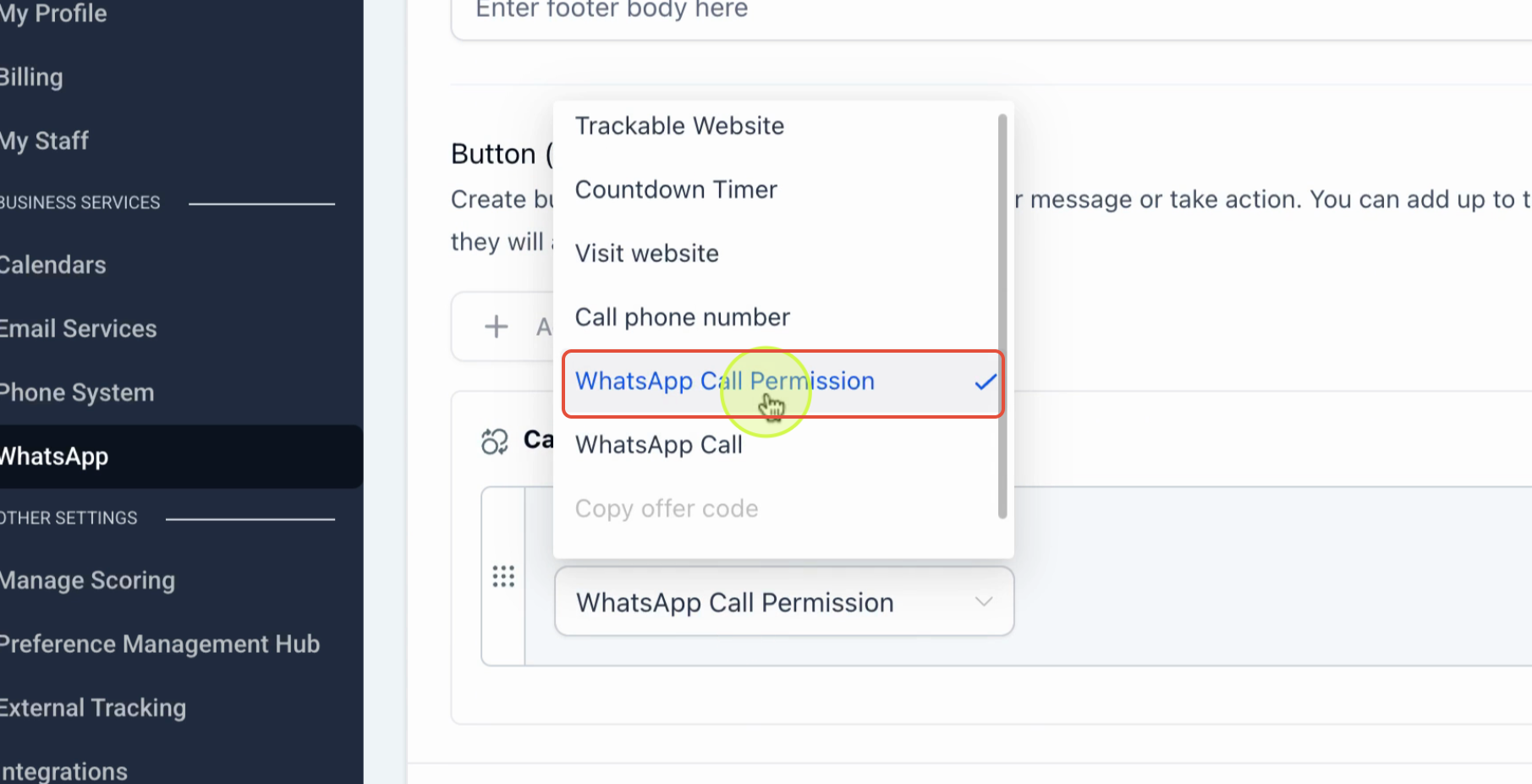
Step 4 When customers receive this message, they tap the provided button to grant permission for a temporary or unlimited duration.
Step 5 You can also include a call button directly in templates and set the permission duration to 1, 7, 15, or 30 days depending on your use case.
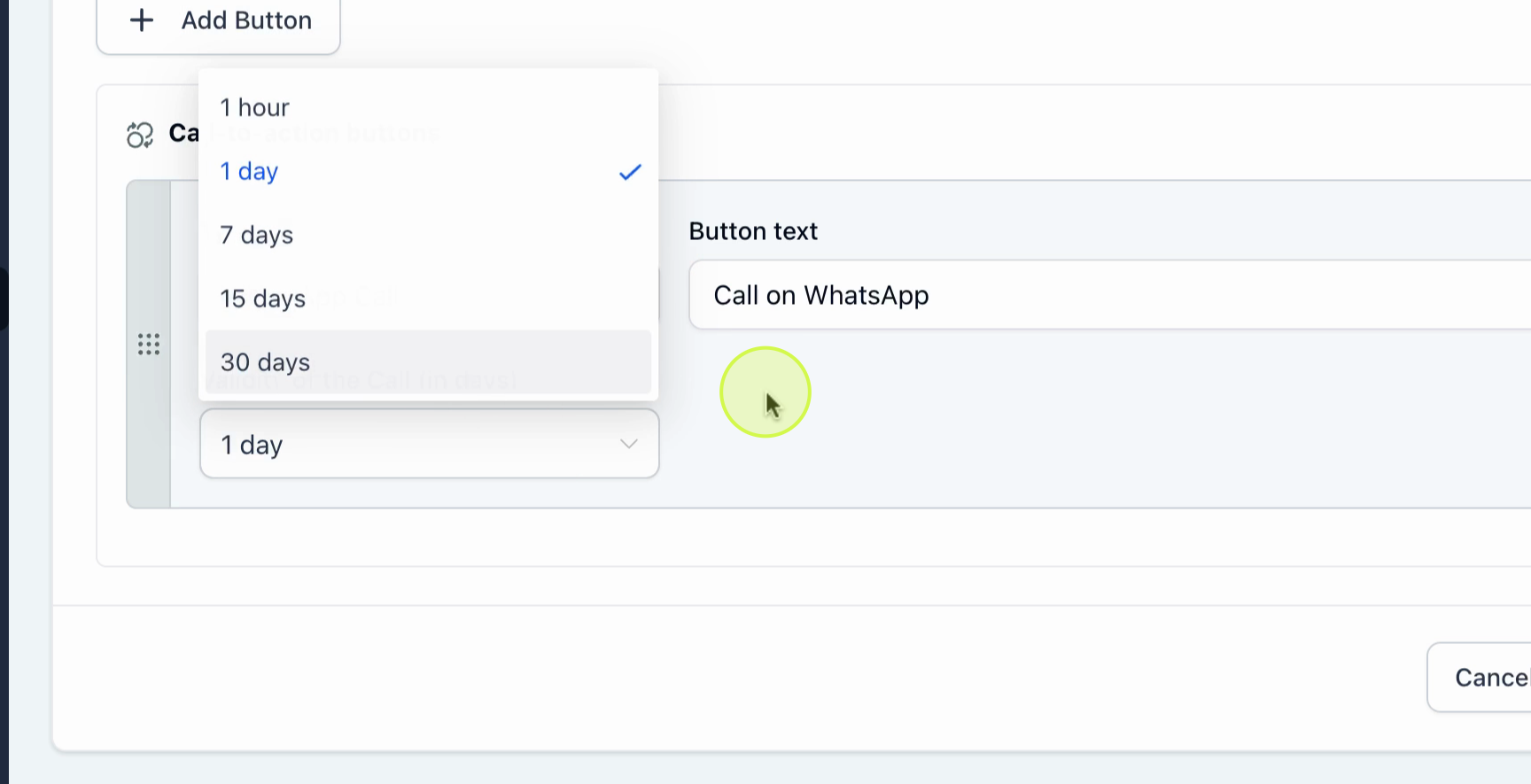
Once customers grant permission, you are ready to handle calls.
Making and Receiving WhatsApp Calls Initiate and receive calls from the Conversations view |
Step 1 Go to Conversations > open any contact > tap WhatsApp as the messaging channel.
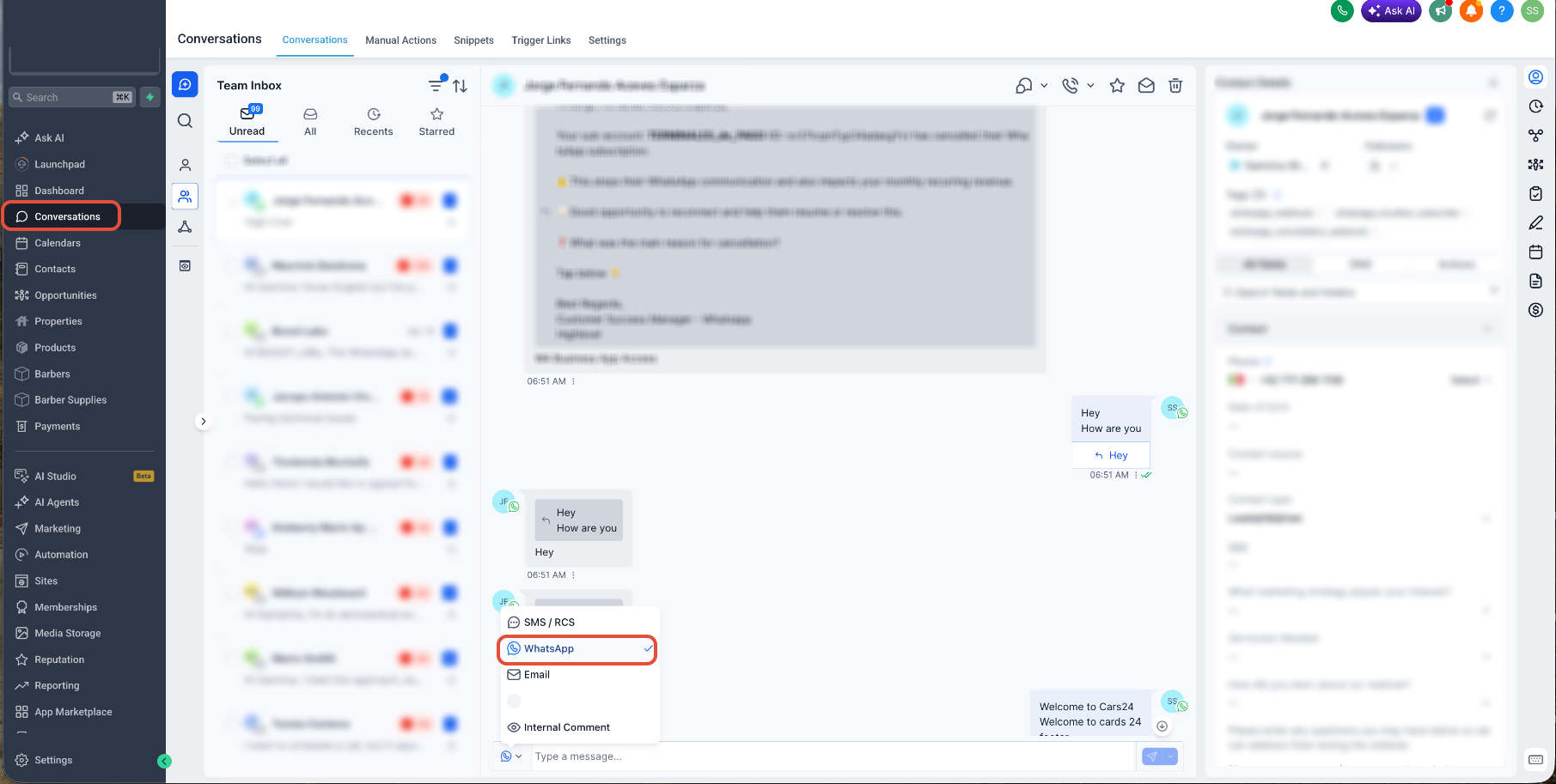
Step 2 Select the messaging template that requests call permission and send it to the customer.
Step 3 Once the customer grants permission, their status will update to "Call permissions active indefinitely" — or display the specific duration they selected.
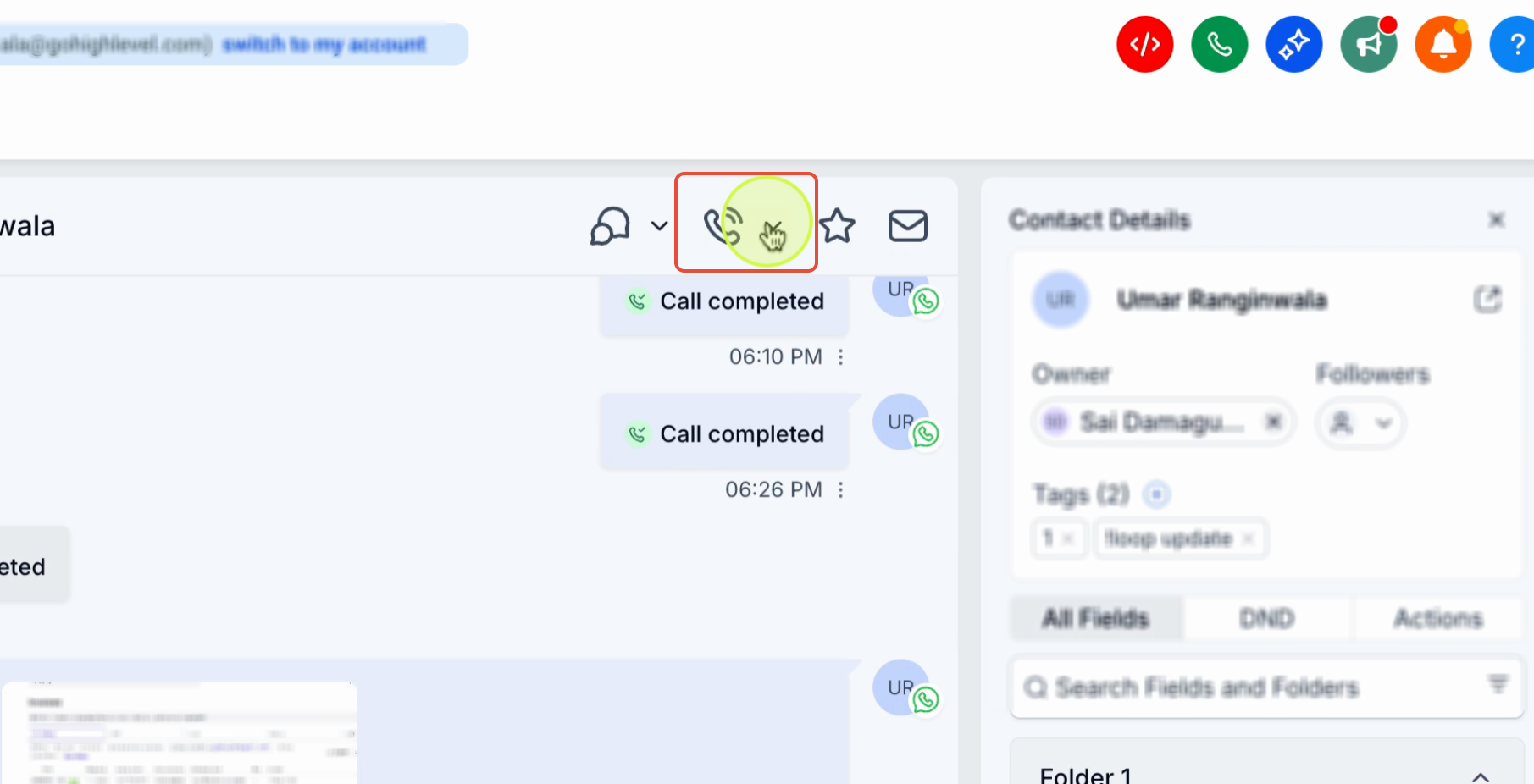
Step 4 When making or receiving a call, you will see options to end the call and add dispositions to log the outcome.
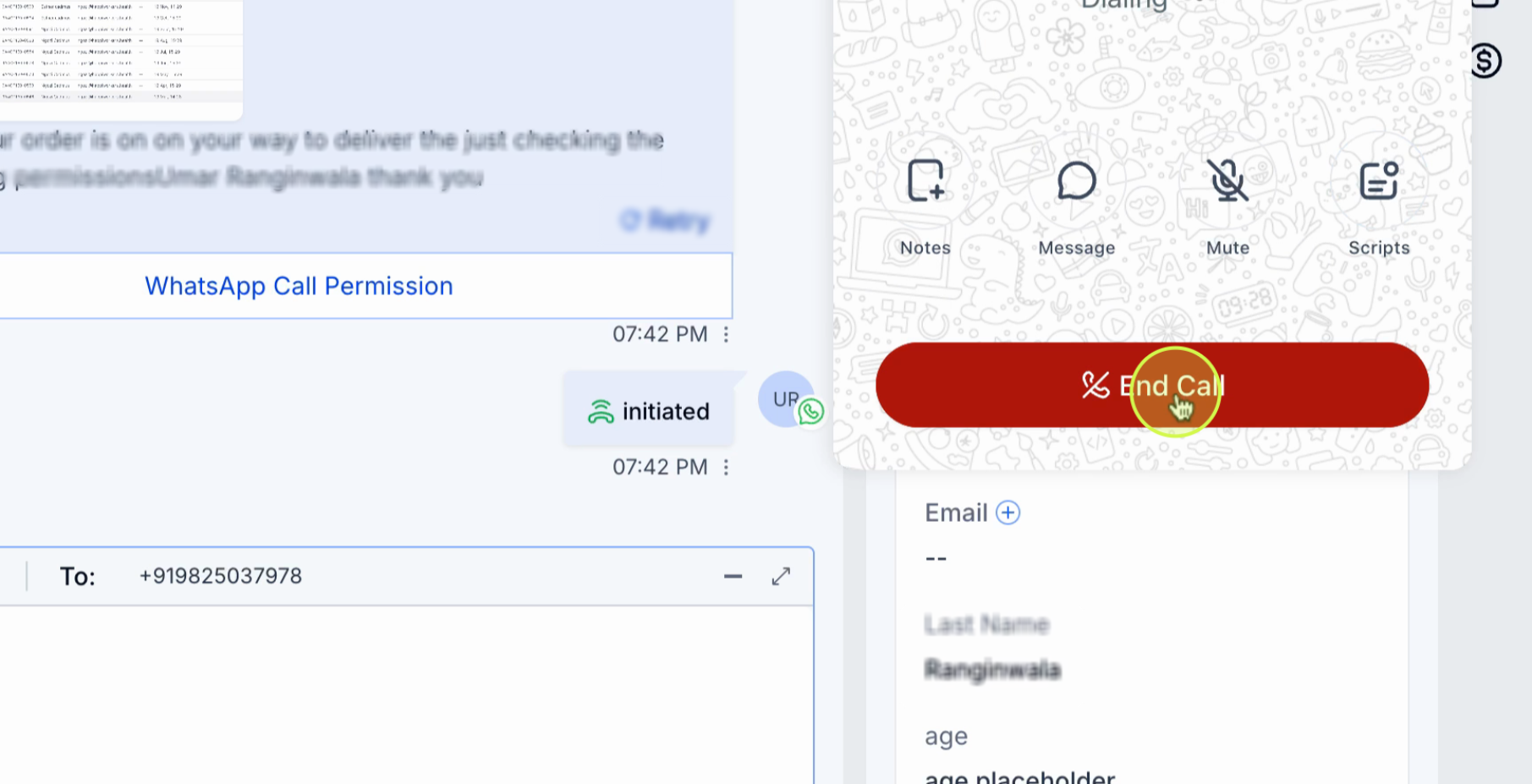
Step 5 For inbound calls, customers can call you directly by tapping the call button on your WhatsApp business profile. The call will ring through to the users assigned in your calling settings.
? Tip: Always add a call disposition after each call to keep your team's records accurate and make follow-ups easier.
Configure Staff User Calling Settings Set the default call channel for each staff member |
Step 1 Go to Settings > My Staff.
Step 2 Search for the assigned staff user and click Edit.
Step 3 Open the Calling & Voicemail tab.
Step 4 Set Default Channel for WhatsApp Calls to either Mobile App or Web App.
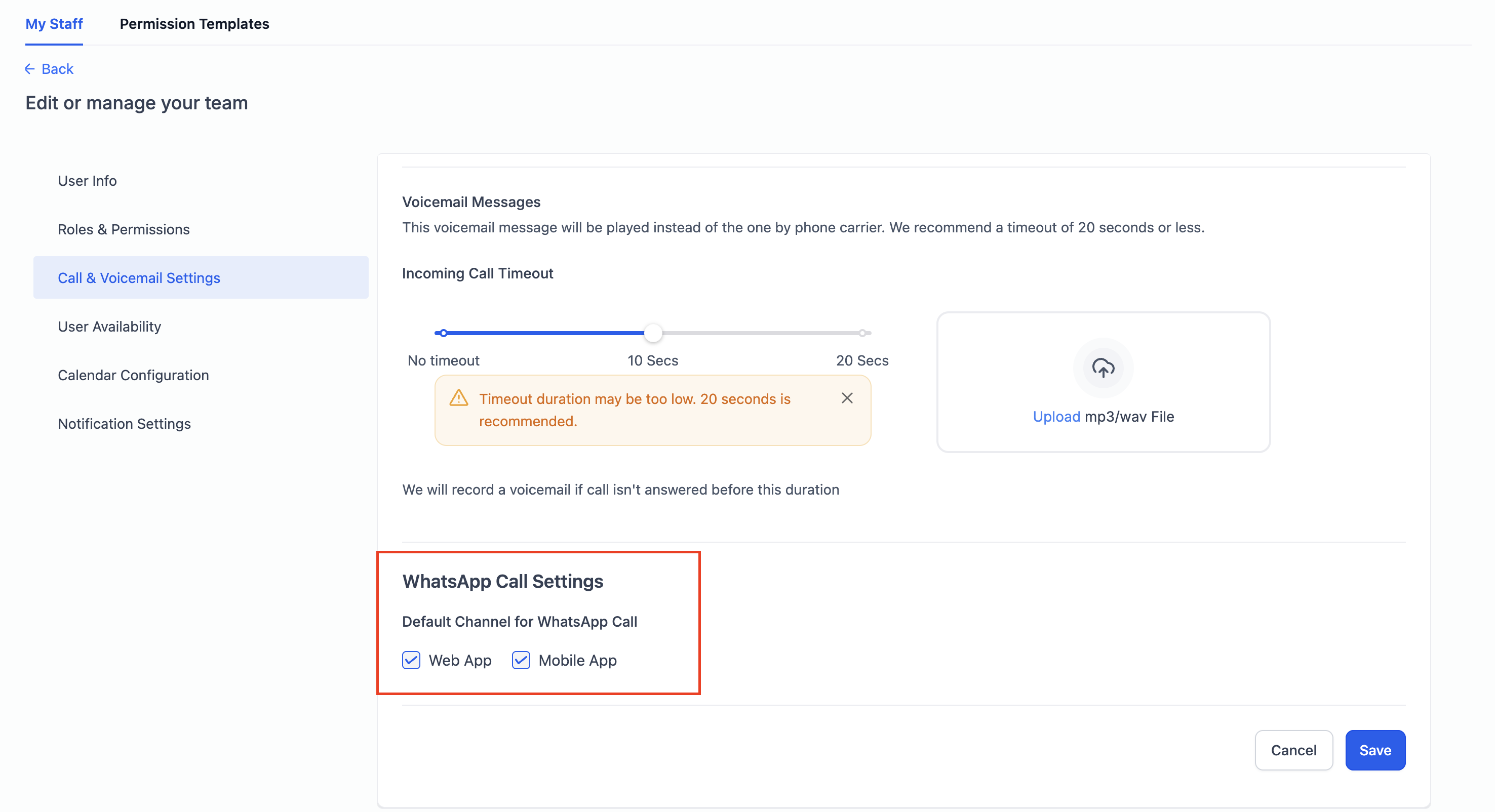
? Mobile App Calls ring on the staff member's mobile device | ? Web App Calls ring in the CRM browser interface |
✅ You're all set! WhatsApp Calling brings fast, reliable voice communication into your existing messaging workflow. Keep your availability settings current, respond to permission requests promptly, and use call dispositions to stay organised — so your team stays reachable and your customers stay engaged. |
Feature Guide WhatsApp User Call Permissions Before your business can place a WhatsApp voice call, the customer must grant permission. This guide explains how permissions work, how to request them, and what happens when they expire or are revoked. |
What you'll learn
|
Overview The user is always in control of call permissions |
If you want to place a call to a WhatsApp user, your business must receive their permission first. The business has no control over this — permission can only be granted or revoked by the user, at any time.
There are three ways a customer can grant call permission:
| |
| |
|
Temporary vs Permanent Permissions Permanent permissions available as of November 3, 2025 |
When a customer approves a call permission request, they choose between two options:
Temporary Permission
| Permanent Permission
|
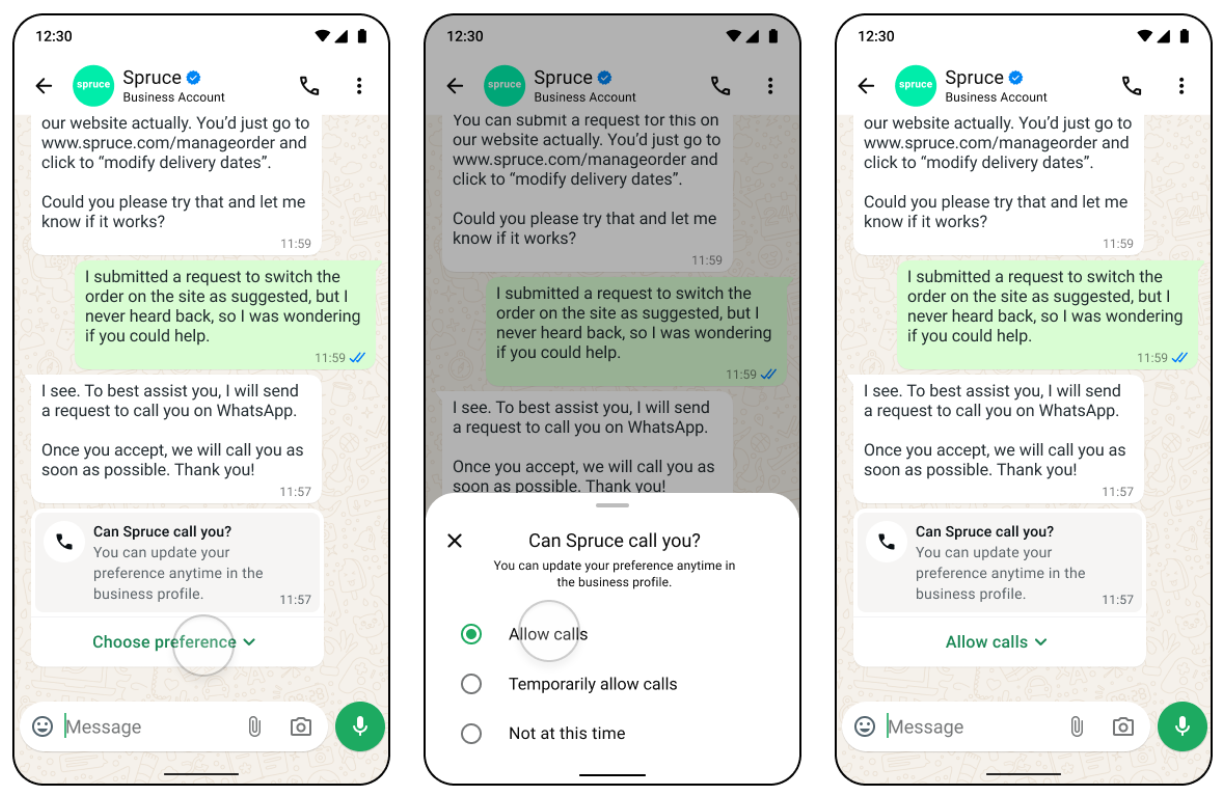
The screenshots below show how the permission options appear to the customer on their WhatsApp app:
Allow Calls (Permanent) 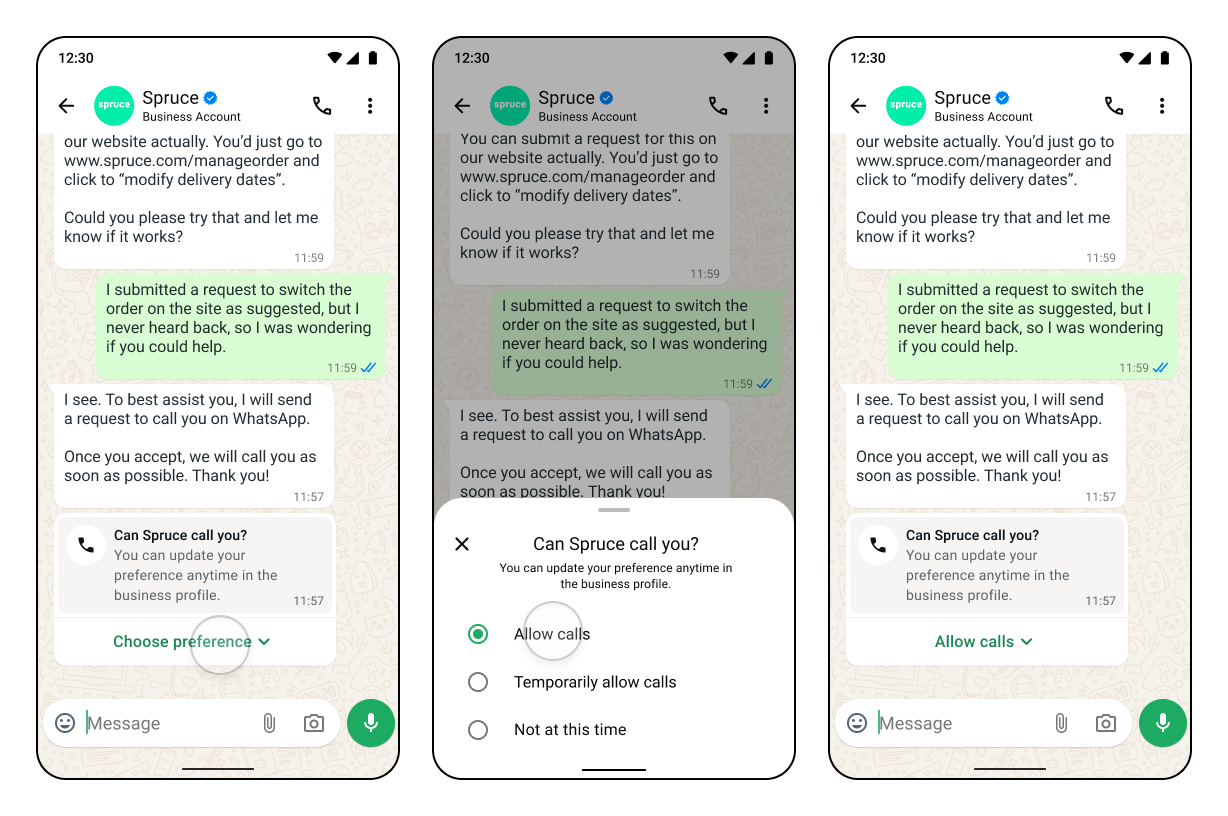 | Temporarily Allow Calls 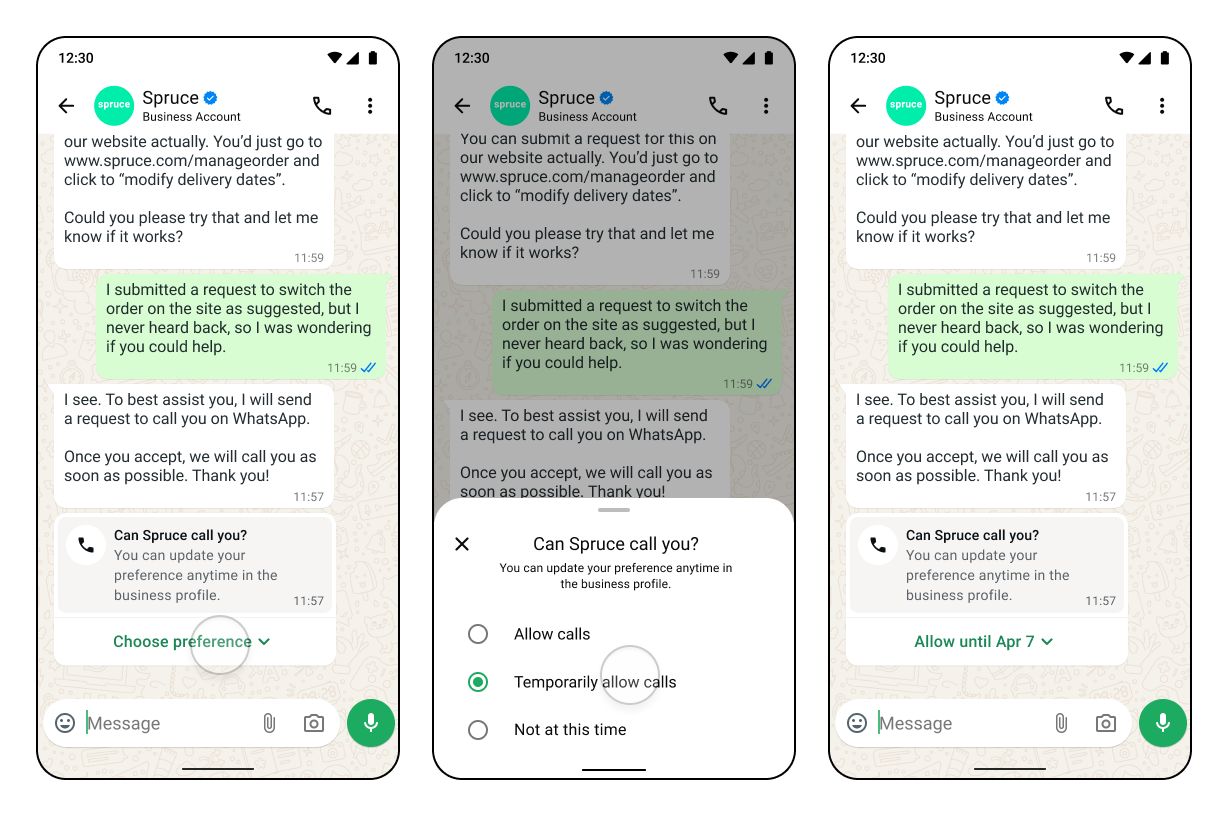 |
Permission Limits Enforced automatically by WhatsApp to protect users |
| Limit | Value |
|---|---|
| Permission requests per contact per day | Maximum 1 every 24 hours |
| Permission requests within a 7-day period | Maximum 2 requests |
| Connected calls per business phone number | Maximum 100 every 24 hours |
| Temporary permission duration | 7 calendar days (168 hours) |
| When limits reset | When any connected call is made between the business and user |
How to Request Call Permission Proactively send a permission request message to the customer |
You can request call permission from a customer by sending a permission request message. The customer can then choose to approve (temporary or permanent), decline, or simply not respond.
Important: Even if a customer approves permission, they can revoke it at any time. Conversely, if a customer declines, they can still choose to grant permission later — up until the request expires.
Free-Form vs Template Messages Choose the right message type based on your conversation history |
? Free-Form Message When to use: You have an open customer service window with the contact.
| ? Template Message When to use: No recent conversation exists with the contact.
|
— Criteria for Sending Call Permission Request Messages
How template messages look to the customer:
Template with Header, Body & Footer 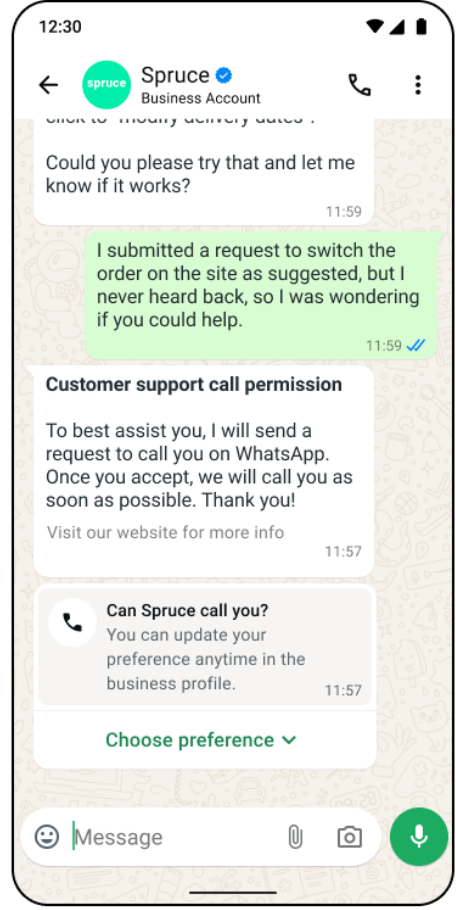 | Template with Body Only 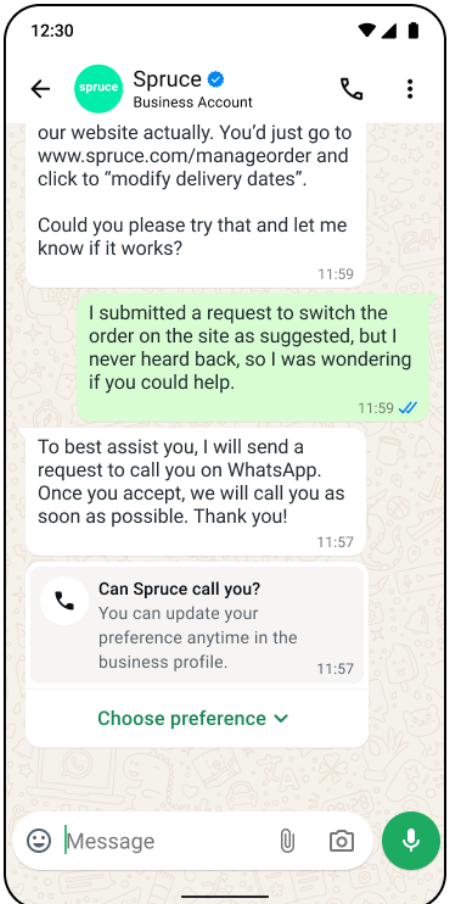 |
Free-Form Message with No Text Body
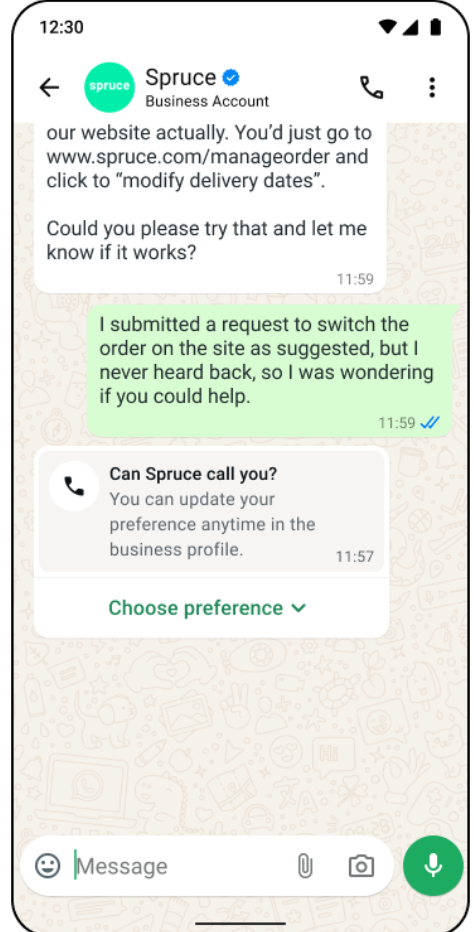
Best practice: Always include a clear, specific reason for the call in your message body. For example: "We'd like to call you to confirm delivery of your order #ON-12345." This context significantly improves customer approval rates.
Consecutive Unanswered Calls WhatsApp automatically protects users from repeated missed calls |
If your business repeatedly calls a customer and the calls go unanswered, WhatsApp takes automatic protective action:
| |
|
Note: Only call customers when there is a clear, relevant reason. Repeated unanswered calls damage trust, trigger automatic warnings, and risk permanent permission revocation.
Permission Request Expiry Scenarios A permission request expires in one of three situations |
| Scenario | What Happens |
|---|---|
| User accepts or declines the request | Request expires 7 days after the user's response |
| User does not respond | Request expires 7 days after delivery |
| A new permission request is sent | The previous request expires immediately |
Expiry scenario screenshots:
Expires After 7 Days (User Responded) 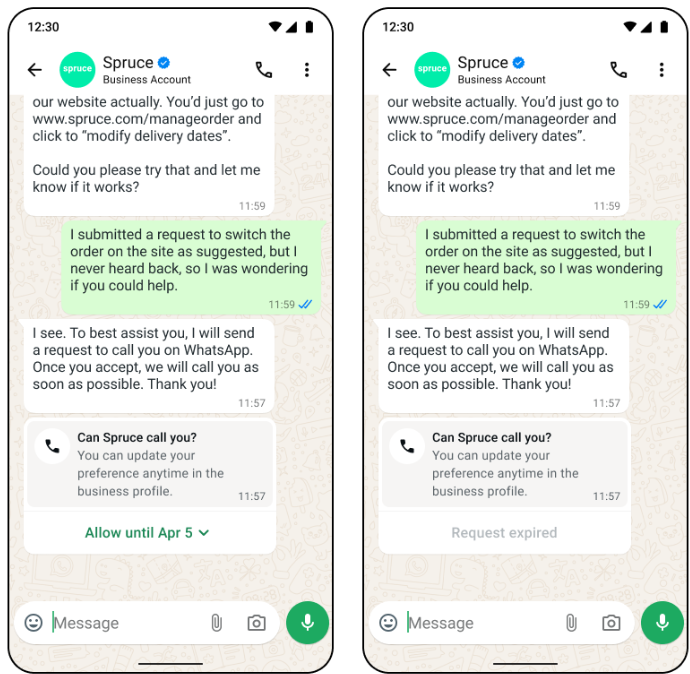 | Expires After 7 Days (No Response) 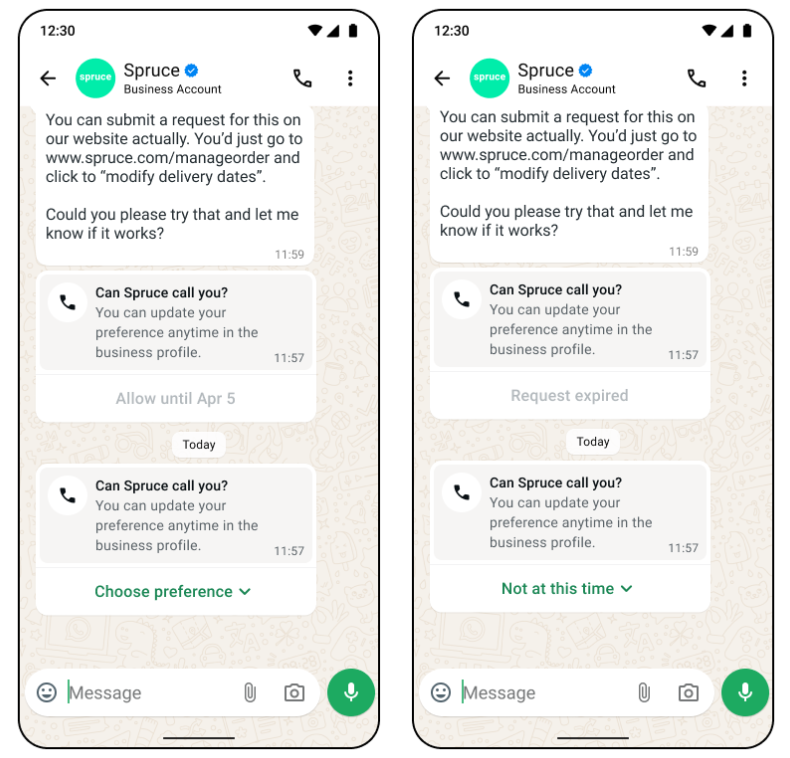 |
Previous Expires, New Request Received 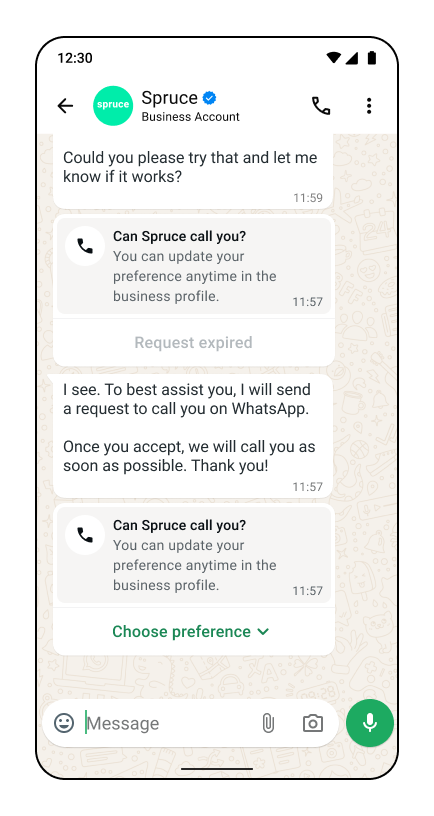 | Previous Expires, User Approves New Request 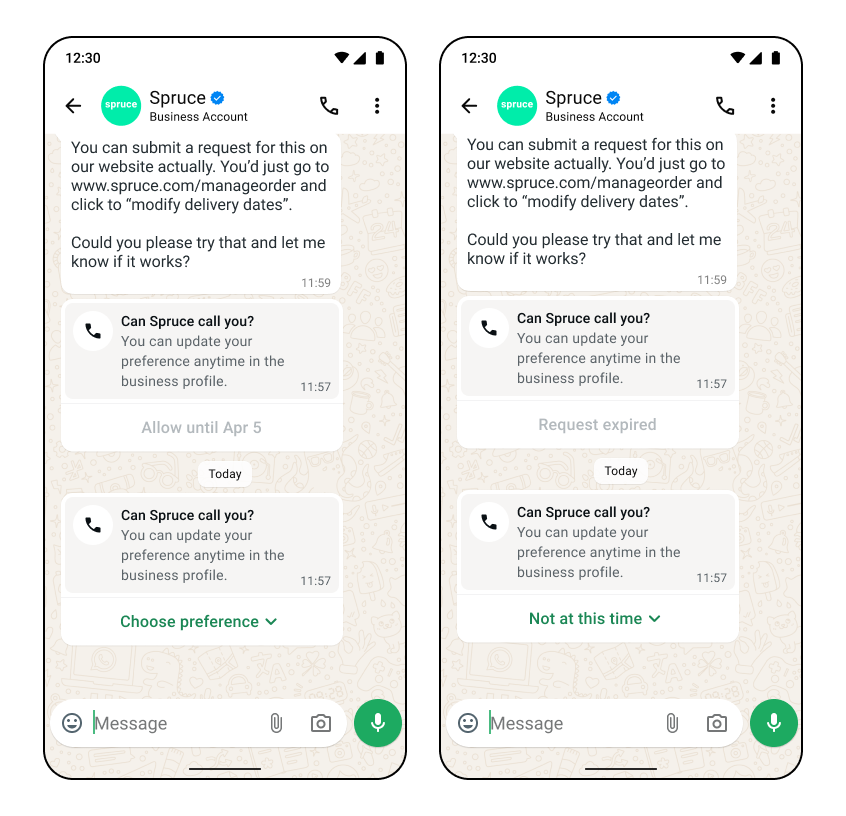 |
No webhook notification is sent when a temporary permission expires. To check the current permission status of a contact at any time, query the Get Current Call Permission State endpoint in the WhatsApp Business API.
✅ Key Takeaways Call permission is always controlled by the user — you can request it, but you cannot force it. Keep messages clear and relevant, respect the request limits, only call when there is genuine value, and handle unanswered calls carefully. This builds customer trust and keeps your permission status healthy. |
WhatsApp Calling Pricing
WhatsApp Calling rates are charged per minute and vary by market. Rates listed below are in USD and apply to business-initiated calls. User-initiated (inbound) calls are free of charge.
User-Initiated Calls
Free
No charge when customer calls your business
Business-Initiated Calls
Per minute
Rate depends on destination market
How Calls Are Billed
Businesses are charged for calls based on:
| |
|
Example: A 56-second call = 9.33 pulses → rounded up to 10 pulses.
Fractional pulses are always counted as one full pulse.
Call Rates by Market (USD per minute)
| Market | Country Code | Currency | Rate per Minute |
|---|---|---|---|
| Argentina | +54 | USD | $0.0106 |
| Brazil | +55 | USD | $0.0113 |
| Chile | +56 | USD | $0.0127 |
| Colombia | +57 | USD | $0.0117 |
| France | +33 | USD | $0.0104 |
| Germany | +49 | USD | $0.0108 |
| India | +91 | USD | $0.0056 |
| Indonesia | +62 | USD | $0.0254 |
| Israel | +972 | USD | $0.0133 |
| Italy | +39 | USD | $0.0127 |
| Malaysia | +60 | USD | $0.0113 |
| Mexico | +52 | USD | $0.0099 |
| Netherlands | +31 | USD | $0.0066 |
| Pakistan | +92 | USD | $0.0125 |
| Peru | +51 | USD | $0.0127 |
| Russia | +7 | USD | $0.0102 |
| Saudi Arabia | +966 | USD | $0.0133 |
| South Africa | +27 | USD | $0.0113 |
| Spain | +34 | USD | $0.0135 |
| United Arab Emirates | +971 | USD | $0.0133 |
| United Kingdom | +44 | USD | $0.0104 |
| Rest of Africa | Various | USD | $0.0108 |
| Rest of Asia Pacific | Various | USD | $0.0120 |
| Rest of Central & Eastern Europe | Various | USD | $0.0100 |
| Rest of Latin America | Various | USD | $0.0122 |
| Rest of Middle East | Various | USD | $0.0133 |
| Rest of Western Europe | Various | USD | $0.0108 |
| Other | Various | USD | $0.0139 |
| Egypt | +20 | USD | N/A |
| Nigeria | +234 | USD | N/A |
| Turkey | +90 | USD | N/A |
| North America (US & Canada) | +1 | USD | N/A |
 User-Initiated Calling
Available in every location where Cloud API is available. No country restrictions apply.

 Business-Initiated Calling

Your business can call customers in most countries. However, calling is not available if your business phone number is registered in any of these countries:
|
|
Note: The country restriction applies to your business phone number. Your customers can be located in any country where WhatsApp is supported.
Frequently Asked Questions Common questions about WhatsApp Calling |
❓ Can I make WhatsApp calls from a desktop browser? Yes. When configuring staff user settings, you can set the Default Channel for WhatsApp Calls to Web App, which allows calls to be handled directly from the CRM browser interface. |
❓ Do I need customer permission before making a call? Yes. WhatsApp requires explicit customer approval before your business can initiate an outbound call. Inbound calls from customers do not require prior permission. |
❓ How long does call permission last? Temporary permission lasts 7 calendar days (168 hours). Permanent permission does not expire. If the customer does not respond to a request, it expires after 7 days. |
❓ How many permission requests can I send to the same customer? 1 request every 24 hours, maximum 2 requests within a 7-day period. These limits reset when any connected call is made between your business and the user. |
❓ Is WhatsApp Calling available in my country? WhatsApp Calling is available in most countries. It is currently not supported in the United States, Canada, Turkey, Egypt, Vietnam, and Nigeria. |
❓ What happens if I miss an inbound WhatsApp call? If a call goes unanswered, the customer can request a callback if you have enabled Allow People to Request Callback for Missed Calls. The missed call is also logged in the customer's conversation. |
❓ Can multiple team members receive the same inbound call? Yes. In Ring WhatsApp Calls To, you can assign a primary user who rings first and add additional team members as backup. If the primary user does not answer, the call routes to the next assigned user. |
❓ Can a customer revoke call permission? Yes. Customers can revoke permission at any time by opening the WhatsApp chat, tapping the business profile name, going to Business Calling Permissions, and disabling call access. |
❓ What is a call disposition and why should I use it? A call disposition is an outcome tag you add after a call — for example, Resolved, Follow-up Required, or No Answer. It keeps records accurate and makes follow-ups easier to track. |
❓ What happens after 4 consecutive unanswered calls? After 2 unanswered calls, WhatsApp sends the user a system message prompting them to reconsider. After 4 unanswered calls, call permission is automatically revoked by WhatsApp. |
Was this article helpful?
That’s Great!
Thank you for your feedback
Sorry! We couldn't be helpful
Thank you for your feedback
Feedback sent
We appreciate your effort and will try to fix the article